
Entry-level jobs, AI and the UK skills gap
A recent UK survey found that more than one in three employers have reduced entry-level opportunities over the past year, with AI and automation among the reasons being cited.
I understand why.
Employing people is expensive.
Minimum wage rises. Employer National Insurance has increased. Statutory employment costs continue to rise. For a small business especially, taking on someone inexperienced can feel like a significant commitment.
So when technology comes along and appears able to do some of that work more cheaply and more quickly, of course businesses are going to look at it.
I would too.
But I think there is a bigger question businesses need to ask before they remove entry-level roles altogether.
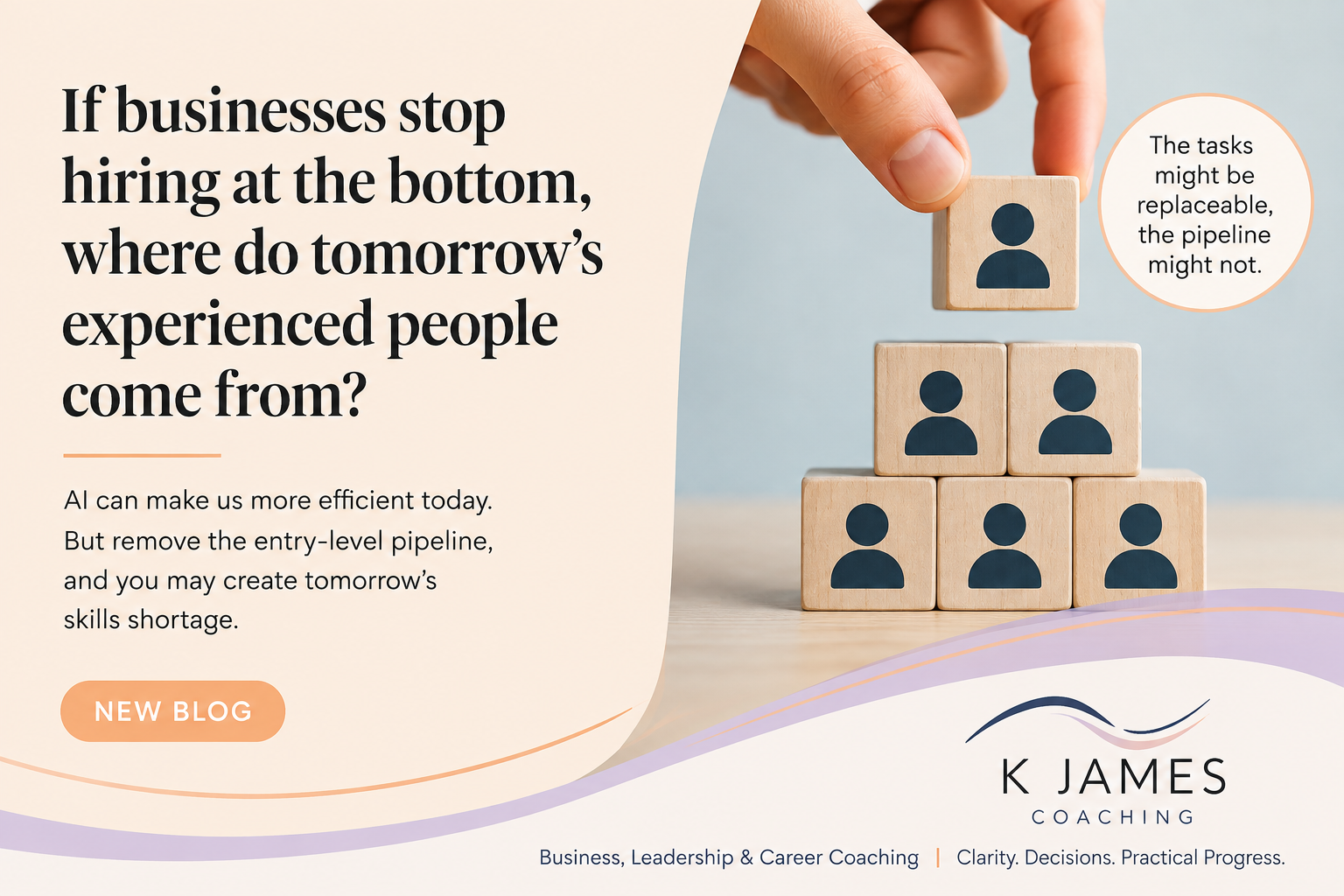
If we stop hiring people at the bottom, where do tomorrow’s experienced people come from?
I spent many years working in a business that was built on internal progression.
People joined at entry level.
They learned the business.
They worked hard because they knew there was somewhere to go.
And they progressed.
Every manager I worked with had started at the bottom.
That mattered.
By the time they were managing teams, making decisions and taking on greater responsibility, they understood what the job was actually like on the ground because they had done it themselves.
They understood the customers.
They understood the systems and processes.
They knew which parts of the operation worked well and which looked good on paper but were much harder in practice.
They understood the pressure their teams were under because they had experienced it.
You can teach management skills.
You can provide training.
You can give somebody qualifications.
But training and experience are not the same thing.
There is a judgement that develops from doing the work, making mistakes, handling difficult situations and gradually taking on more responsibility.
That experience becomes part of what makes somebody a good manager or leader later.
And entry-level employees are not simply there to develop themselves either.
They also support the people above them.
It is easy to look at a junior role and ask:
Can AI perform these tasks?
Sometimes the answer will be yes.
But that only looks at the role in isolation.
A better question might be:
What function does this person perform within the wider business?
They take work from more experienced colleagues.
They learn from them.
They ask questions.
They notice things.
Over time, they take on more responsibility.
Eventually, some of them become the people the business relies on.
If you remove that layer completely, some of the work may disappear through automation.
But not all of it will.
Some of it simply moves upwards.
Your more experienced people end up doing work that previously sat further down the organisation, while at the same time there are fewer people underneath them developing the experience needed to replace them later.
That is where I think we risk creating a much bigger problem.
Today, businesses can still recruit experienced supervisors, managers and specialists because those people already exist.
But experience has to start somewhere.
Someone has to give people their first opportunity.
Someone has to train them.
Someone has to let them make mistakes.
Someone has to give them progressively more responsibility.
If businesses collectively reduce those opportunities now, we may not see the full impact immediately.
We may see it several years from now, when businesses are trying to recruit experienced people and discovering the pool is much smaller.
And then we will call it a skills shortage.
The irony will be that we helped create it.
None of this means businesses should ignore AI.
I use AI myself and I think it can be incredibly useful.
Used well, it can remove repetitive work, improve productivity and give people more time to focus on the things that require judgement, communication and experience.
But there is a difference between using technology to make people more effective and using it to remove the development pipeline altogether.
Before automating an entry-level role out of a business, I think leaders need to look beyond the immediate tasks and consider what else they may be removing with it.
Because the tasks might be replaceable.
The pipeline might not be.
Sometimes a decision solves today’s problem while quietly creating tomorrow’s.